In 1935, a legendary gun was born: the S&W .357 Magnum, commonly known as the Registered Magnum. With the introduction of the model number system, the model later known as the S&W M27 was born. The .357 Magnum round, which remains in use to this day, was born at the same time.
Upon its release, it was advertised as "the most powerful revolver in the world." This high-powered handgun was purchased not only by general gun enthusiasts but also by law enforcement officers.
However, as the name "registered" suggests, the initial sales were not general sale, but were made to order, with a registration certificate that also served as a quality guarantee. Customers could choose the sights, barrel length, finish, and even grip, but due to the demand for custom orders, monthly production capacity was initially around 120 units. Then, orders for several thousand units began pouring in. S&W was delighted.
Production was temporarily halted during World War II, but production resumed after the war with a renewed model. The postwar version, "The .357 Magnum," was also in high demand among law enforcement agencies, but the price was a major issue. This custom gun was too expensive. Police departments across the United States asked S&W to "make the .357 Magnum as cost-effective as possible."
S&W responded to this request by leaving the internal mechanism untouched and minimizing the appearance, placing emphasis on reliability. Based on the .357 Magnum, the surface was changed from a polished finish to a semi-polished finish, and the anti-reflective checkering on the top of the frame and barrel was eliminated in favor of a blasted finish.
The barrel was also limited to a choice of either a 4-inch or 6-inch, with a semi-wide hammer and narrow trigger. This reduced the cost by nearly $100 at the time. This was the birth of the "budget version" of the .357 Magnum.
When this rifle was released in 1954 as "The Highway Patrolman," it was adopted by law enforcement agencies across the United States. When the model numbering system was introduced, it was numbered as the "S&W M28."
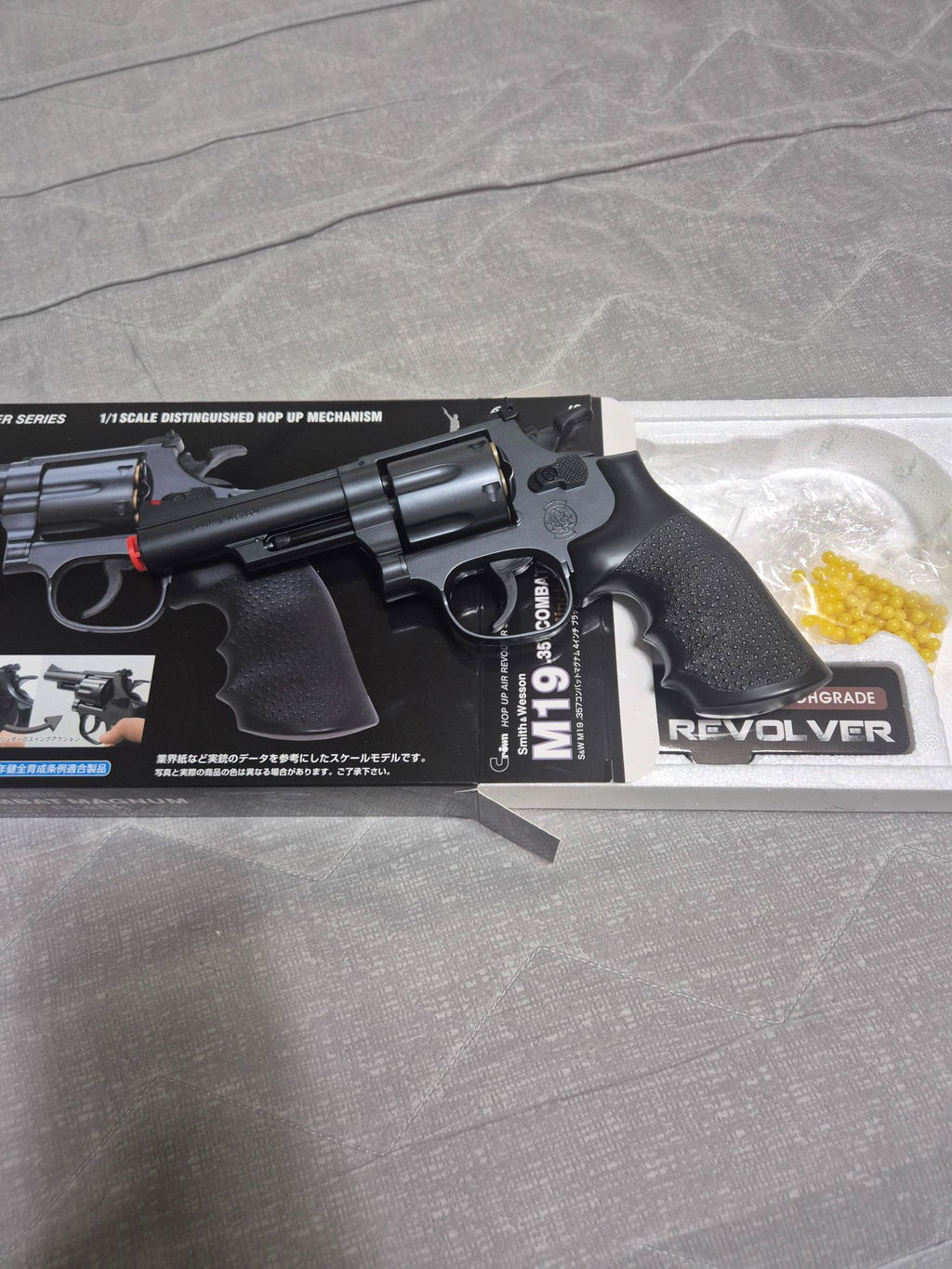
The following year, in 1955, the .357 Combat Magnum (later the M19) was released.
In terms of durability, the larger and thicker N-frame based .357 Magnum x 6 (M19) and the N-frame based .357 Magnum x 6 (M28) are the clear winners, but the lighter M19 seems to have been preferred for carrying around all the time (in the case of the actual gun, the M19 was about 90g lighter than the 4-inch model).
However, the M28 was apparently much cheaper than the M19 even at the time, and the decision to adopt it was based on the financial situation of each police department or law enforcement agency.
Tanaka's "S&W M28 "The Highway Patrolman" 4-inch Heavy Weight Model Gun" is a model based on the post-model number system. It perfectly recreates the M28's appeal, including the frame and barrel top finish, which was changed from the M27, the distinctive K-sight without anti-reflective grooves, the massive counterbored cylinder that extends to the rim of the cartridge to withstand the unreliability of the primers of the time and the high-pressure cartridges, the semi-wide hammer, and the narrow trigger. Of course, the cartridge used is the .357 Magnum. The internals are based on the latest version .2 of our S&W N-frame model guns, thoroughly recreating the smooth trigger feel that S&W aimed for without compromising on the internals.
The Hi-Patrol, a famous model gun from the past in Japan, is being revived in the Reiwa era with modern technology!

▲Simplified sights. The rear sight without checkering looks fresh in today's world.

Counterbored cylinder. You can see that there is plenty of room for six .357 Magnum rounds in the N frame.
【specification】
Magazine capacity: 6 rounds Length: 235 mm
・Weight: 750 g
Material: HW resin + zinc die-cast. Includes six .357 magnum firing cartridges. Frame type: N frame, square butt.
- 7mm cap gunpowder firing system
*Please note that the specifications such as product weight may vary slightly depending on the production lot.



![[Tanaka] S&W M28 “The Highway Patrolman” .357 Magnum 4-inch HW Model Gun](http://rock-et.jp/cdn/shop/files/4537212011334_1024x1024.jpg?v=1772699585)